

Acrylic wins for anything large, heavy or likely to travel; glass wins for small, static pieces and friable media like pastels. The exception that trumps both rules: irreplaceable artwork, where conservation-grade glass or Optium Museum Acrylic® takes priority over cost or convenience. For bespoke commissions, a professional framer such as Frametheworld can weigh the specific piece against these trade-offs before you commit.
TL;DR:
- Acrylic is roughly half the weight of glass at equal thickness, reducing the hardware needed for large frames and making shipping easier.
- Acrylic is more impact resistant and less likely to shatter into sharp fragments, making it safer for high-traffic or children’s spaces.
- Museum-grade glass provides superior stability and humidity protection, while acrylic is better suited for large, portable, or shipping-heavy artwork.
- Conservation-grade acrylic blocks up to 99% of UV light and offers anti-reflective coatings that preserve fine details without glare, unlike cheaper options.
- Proper handling and cleaning habits are essential to avoid scratches, static damage, and fogging, especially with acrylic in humid or frequently handled environments.
Table of Contents
- Acrylic vs glass framing: how the materials actually differ
- Optical performance and preservation: clarity, glare and UV protection
- Cleaning, scratches, shipping: the real lifecycle costs
- Which glazing suits your specific situation
- Cleaning, handling and spotting glazing problems early
- What professional framers actually recommend
- Why the “just pick the cheaper one” advice fails buyers
- Ready to commission your piece with the right glazing
- Sources
Acrylic vs glass framing: how the materials actually differ
Weight is the first thing you notice. Acrylic runs roughly half the weight of glass at equal thickness, which changes what hardware your wall can safely carry. Large glass-glazed pieces often require reinforced hardware due to weight. Acrylic lets you hang the same size frame on fittings suitable for lighter weight.
Impact behaviour is the bigger safety story. Glass can shatter into sharp fragments under stress; acrylic flexes and can be 10 to 20 times more impact resistant before it fails, and when it does fail it tends to crack rather than shower glass across a room. That matters in hallways, stairwells, children’s bedrooms, or anywhere a frame might get knocked.
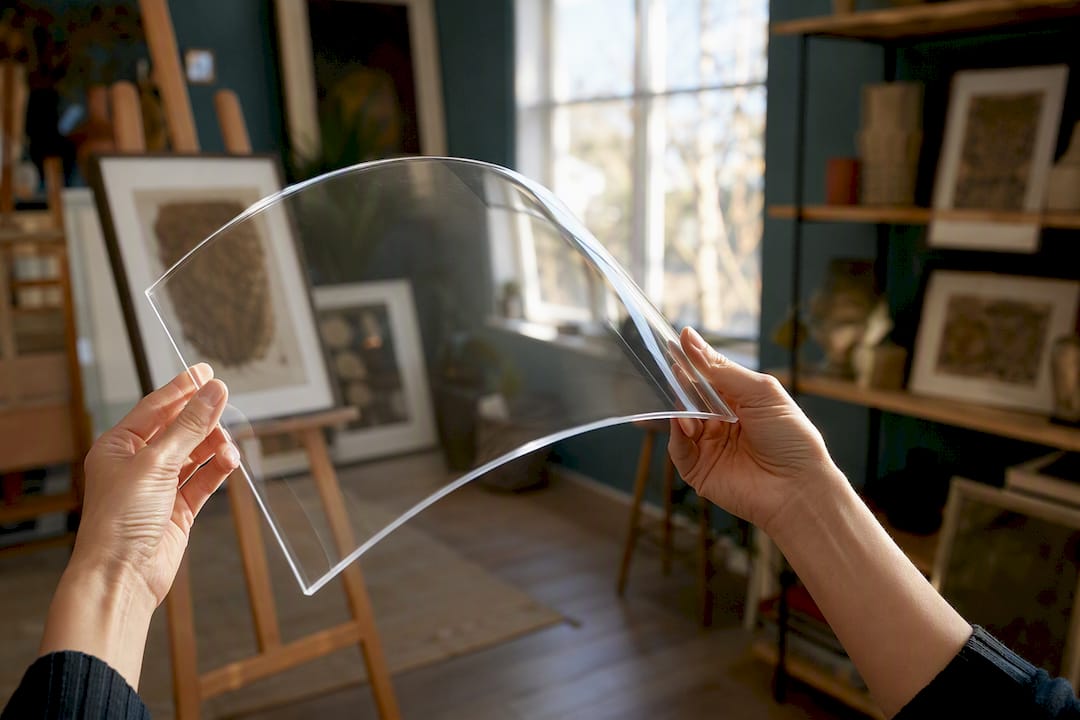
Where glass claws back ground is stability. Glass is a rigid, non-warping vapour barrier, which keeps humidity out of a sealed package far more reliably than acrylic. Acrylic can warp toward whichever face sits in damper air, so it’s a weaker seal for long-term enclosed storage.
Static charge effects are important considerations for buyers:
- Acrylic generates static through friction and handling, which can pull loose pigment straight off the surface of a piece.
- This makes it a genuine risk for pastels, charcoal and chalk drawings.
- Glass carries negligible static charge, preferred for friable media.
- Humidity swings affect acrylic’s flatness over time in ways glass simply doesn’t experience.
Optical performance and preservation: clarity, glare and UV protection
“Conservation grade” isn’t a marketing label. It refers to a specific UV-blocking threshold: glazing needs to filter at least 97% of UV in the 300–380 nanometre range to earn a “photo-safe” classification under the ISO 18902 and ISO 18916 framework that photo preservation standards reference. Below that threshold, fading accelerates on anything exposed to daylight or strong indoor lighting.
At the premium end, the two materials are remarkably close in performance:
- Museum Glass: reflection under 1%, high light transmission, rigid vapour barrier.
- Optium Museum Acrylic®: blocks up to 99% of UV, reflection under 1.6%, light transmission above 98%, available in 3.0mm, 4.5mm and 6.0mm thicknesses.
Non-glare and true anti-reflective coatings are different things worth knowing apart. Cheaper “non-glare” finishes etch the surface, which softens reflections but also slightly blurs fine detail underneath. Genuine anti-reflective coatings on both museum glass and Optium Museum Acrylic cut reflection dramatically without sacrificing sharpness, which is why they cost more.
The practical call: choose glass museum grades for smaller, stationary pieces. Choose Optium Museum Acrylic for anything large, valuable and likely to be shipped, rehung or handled repeatedly.
Cleaning, scratches, shipping: the real lifecycle costs
Sticker price tells you almost nothing about what a piece costs to own over ten years. The maintenance habits differ enough that getting them wrong causes visible, sometimes permanent damage.
- Cleaning acrylic demands mild soap and water or a dedicated ammonia-free plastic cleaner, applied with a microfibre cloth. Standard glass cleaner containing ammonia will craze and cloud acrylic permanently within one or two applications.
- Cleaning glass is more forgiving. It tolerates stronger commercial glass cleaners and doesn’t scratch from routine wiping, though anti-reflective coatings still deserve a soft cloth.
- Scratch resistance favours glass in daily use, since standard acrylic is noticeably softer. Abrasion-resistant hard coats close much of that gap, and minor acrylic scratches can sometimes be buffed out, unlike a scratched glass surface, which usually means replacement.
- Yellowing affects lower-grade acrylic over years of UV exposure; conservation-grade acrylic resists this far better. Glass doesn’t yellow at all.
- Shipping and hanging costs run consistently lower for acrylic. It ships flat, survives freight handling better, and needs less robust crating than glass, which is precisely why galleries specify it for touring exhibitions.
Pro Tip: Keep a soft microfibre cloth dedicated solely to your framed pieces, and never reach for whatever spray bottle is under the sink. One wrong cleaner on acrylic is a mistake you can’t undo.
Which glazing suits your specific situation
Matching glazing to context beats any blanket rule. The framer’s shorthand is genuinely useful here: bigger and busier means acrylic; smaller and delicate means glass.
- Children’s rooms, hallways, offices and public spaces: acrylic, for the shatter resistance alone. A knocked frame becomes a minor inconvenience rather than a hazard.
- Large statement pieces or anything moved between homes: acrylic, purely on weight and shipping economics. A 40x60 inch piece in glass needs two people and reinforced hardware; the same size in acrylic doesn’t.
- Small, stationary works that will hang in one spot for years: glass, for its rigidity and lack of static.
- Pastels, charcoal, chalk pastels, and any powdery medium: glass, without exception, because acrylic’s static charge can lift pigment straight off the paper.
- Irreplaceable pieces, whether an inherited portrait or a significant original: conservation-grade glass or Optium Museum Acrylic, chosen by weight and handling needs rather than price. If it needs to travel, Optium Museum Acrylic is the safer bet; if it’s staying put in a controlled environment, museum glass edges ahead on vapour sealing.
Wall placement and household traffic patterns often decide this faster than any spec sheet does. If you’re unsure how your space factors in, it’s worth reading how frame selection affects your home and art before committing to a glazing type.
Cleaning, handling and spotting glazing problems early
Most glazing failures come from handling mistakes, not material defects. A short routine prevents nearly all of them.
- For acrylic, spray a mild soap solution or ammonia-free plastic cleaner onto the cloth, never directly onto the surface, and wipe in straight lines rather than circles to avoid micro-scratching.
- For glass, use a standard glass cleaner on a soft cloth; anti-reflective coatings need a gentler touch and a dry microfibre finish.
- When handling large sheets, support the full underside rather than gripping the edges alone. Uneven pressure on glass panels over roughly 30x40 inches risks mitre separation or frame sag without reinforced bracing at the corners.
- Apply anti-static wipes to acrylic before hanging anything containing pastel or charcoal media, even if the piece is already sealed.
- Check for condensation or fogging at the edges every few months in humid rooms. Fogging inside the glazing usually signals a broken seal, and at that point the frame needs reglazing rather than another clean.
Pro Tip: If you’re hanging anything over 30x40 inches in glass, get a second pair of hands. A dropped sheet that size isn’t just an expensive mistake, it’s a genuine safety hazard.
What professional framers actually recommend
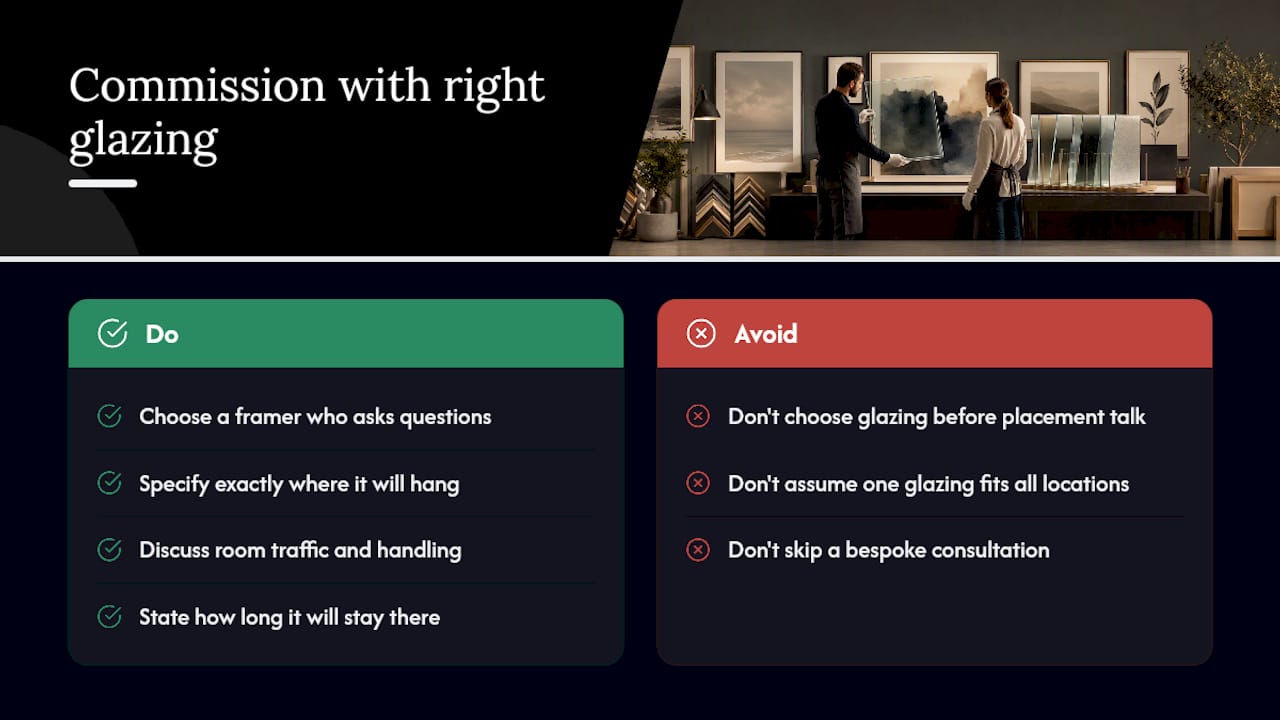
Frametheworld’s approach to bespoke commissions starts with the same questions a good framer always asks: how big is the piece, where is it going, and will it ever move again. Those three answers decide the glazing before price even enters the conversation.
- Safety governs anything destined for a hallway, stairwell or a home with children, which pushes the recommendation firmly toward acrylic regardless of the artwork’s value.
- Weight decides oversized commissions. A large canvas or print heading to a client’s second home or a commercial installation gets specified in acrylic to keep shipping and hanging manageable.
- Conservation priorities override both when the piece is one-of-a-kind. Museum-grade glazing gets specified whenever a client is framing an heirloom, an original, or a limited-edition print they consider irreplaceable.
For readers weighing up materials more broadly, Frametheworld’s guide to framing options and materials covers the wider specification choices beyond glazing, and the case for professional framing built to last explains why these decisions compound over a piece’s lifetime.
Why the “just pick the cheaper one” advice fails buyers
The conventional advice treats this as a budget decision. It isn’t. Most of the damage I’ve seen described in framing forums and conservation guides traces back to a mismatch between glazing and context, not glazing and price. Someone frames a pastel behind standard acrylic because it was cheaper, and loses pigment to static within a year. Someone else hangs a huge glass-glazed print in a rental hallway and it becomes a genuine hazard the first time it’s knocked.
The single question worth asking before anything else isn’t “acrylic or glass” but “will this piece move, and can it be replaced?” Answer both honestly and the glazing choice mostly makes itself. Where I’d push back on typical guides is the assumption that conservation grade is only for gallery pieces. If a print has sentimental weight you couldn’t replace, museum-grade glazing earns its cost regardless of what you paid for the artwork itself.
Prioritise handling and permanence over sticker price, and the rest of this comparison falls into place.
— Lennard
Ready to commission your piece with the right glazing
Choosing between acrylic and glass is only half the job. The other half is finding a framer who asks the right questions about your specific piece before recommending either one. Frametheworld builds bespoke, hand-painted wall art and custom commissions with glazing specified around how the piece will actually live in your home, whether that’s a statement canvas above a staircase or a smaller original destined for one quiet wall for good.
Browse the hand-painted abstract collection or the bold retro and modern pieces to see the range, then get in touch to discuss a bespoke commission specified to your space, your traffic, and how long you plan to keep it exactly where it hangs.
Sources
For readers who want the underlying technical detail, Tru Vue’s own breakdown of glass versus acrylic trade-offs and its Optium Museum Acrylic specification page are the primary sources behind most of the industry figures cited here. If UV exposure near windows concerns you beyond framing, this UV protection guide for windows covers the broader fading problem in a room.
- Glass or Acrylic for Framing? Pros, Cons & Considerations
- Acrylic vs Glass for Framing Art: Which Glazing Wins?

Laat een reactie achter
Deze site wordt beschermd door hCaptcha en het privacybeleid en de servicevoorwaarden van hCaptcha zijn van toepassing.