

TL;DR:
- Art consultancy helps clients select and manage art collections that match their spaces, budgets, and goals. It involves sourcing, curation, installation, and ongoing management, with fees usually based on percentage or flat rates. Transparency and early integration with design are vital for achieving cohesive and valuable art outcomes.
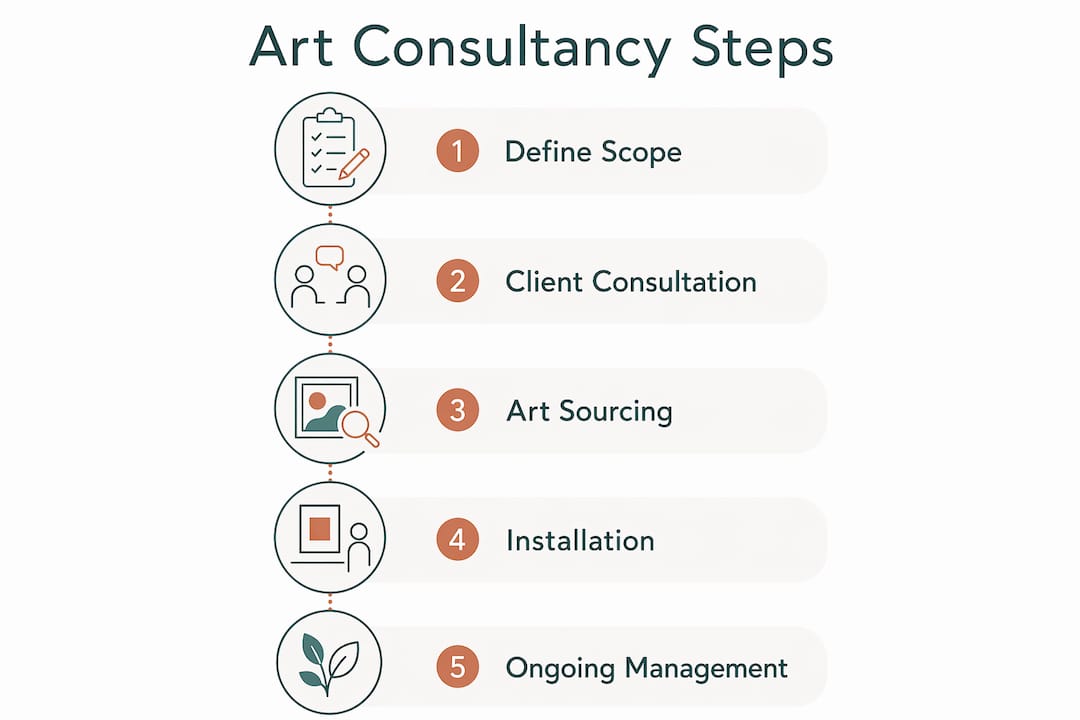
Art consultancy is the professional service of advising individuals and organisations on acquiring, curating, and managing art collections to enhance spaces aesthetically and functionally. Also known as art advisory, it covers everything from sourcing a single statement piece for a living room to building a multi-site corporate collection. The service sits between the art market and the client, acting as an independent guide rather than a seller. For private collectors, businesses, and public institutions alike, art consultancy removes guesswork and replaces it with informed, purposeful selection.
What is art consultancy and what does it actually cover?
Art consultancy is a structured advisory service that matches clients with artworks suited to their space, budget, and long-term goals. The consultant acts as the client’s representative in the art market, not as a gallery trying to shift stock. That independence is the defining feature of the profession. A good consultant brings market knowledge, aesthetic judgement, and logistical coordination to every project.
The scope of art consultancy services is broader than most clients expect. A consultant may handle:
- Art sourcing and acquisition — identifying works from galleries, auction houses, artist studios, and private collections
- Curation and collection building — selecting pieces that work together as a coherent body of work
- Custom commissions — briefing artists directly to create bespoke works for specific spaces
- Installation coordination — managing framing, lighting, hanging, and transport
- Collection management — cataloguing, insurance valuation, conservation advice, and rotation planning
- Art leasing — arranging short-term access to artworks for offices or hospitality venues
Clients range from private homeowners refreshing a single room to architects specifying art for an entire new development. Interior designers frequently bring in art consultants to complete a scheme once the spatial design is set. Businesses use art advisory for commercial spaces to reinforce brand identity, improve staff wellbeing, and create memorable client environments. The common thread is that every client wants art that fits, not just art that is available.
How do art consultants charge for their services?

Fee structures in art consultancy follow two main models, and understanding them protects clients from unexpected costs. Art consultants typically charge either a percentage of the total acquisition cost or a flat project-based rate. Percentage fees are common for collection-building projects where the total spend is large and variable. Flat rates suit defined briefs with a clear scope, such as sourcing art for a single office floor.
Specialist services carry their own pricing. Art leasing, for example, starts at around £800 per month for a curated selection, making it a practical option for businesses that want to refresh their spaces regularly without committing to purchases. Ongoing collection management, including insurance valuations and conservation oversight, is usually billed separately on a retainer basis.
The most important fee issue is transparency. Undisclosed commissions from galleries can compromise the advice a client receives, because a consultant earning a hidden margin from a gallery has a financial reason to recommend that gallery’s work over better alternatives. These are sometimes called “shadow commissions” in the industry. Clients should always ask for direct invoicing and written confirmation that the consultant’s only income from the project comes from the agreed client fee.
Independent consultants who work solely for their clients can also secure 10–20% savings through volume leverage and broader sourcing networks. That saving often covers the consultant’s fee entirely. The financial case for hiring a consultant is stronger than most clients realise before they start.
- Agree the fee model in writing before any sourcing begins.
- Ask whether the consultant receives any payment from galleries, artists, or auction houses.
- Request direct invoicing for all artwork purchases so you can see the actual cost.
- Clarify whether installation, framing, and transport are included or billed separately.
- Confirm the process for ongoing management if you want continued support after acquisition.
Pro Tip: Ask your consultant to provide a sample invoice from a previous project. A transparent consultant will show you exactly how costs are broken down, with no blended or hidden margins.
How to choose an art consultant for your project
Choosing the right art consultant starts with matching their specialisation to your goals. A consultant who focuses on contemporary painting for private collectors is not the best fit for a hospitality group seeking large-scale sculptural installations. Matching specialisation to project goals consistently produces better outcomes than hiring by reputation alone. The most celebrated name in the industry is irrelevant if their expertise does not align with your brief.
The initial meeting is a genuine evaluation tool. Assessing communication style and project alignment in early conversations sets the foundation for the entire working relationship. Pay attention to whether the consultant listens more than they talk. A consultant who arrives with a fixed shortlist before understanding your space and preferences is prioritising their own convenience over your outcome.
Ask these questions before committing:
- What is your fee structure, and do you receive any income from galleries or artists on this project?
- Can you show examples of projects similar in scale and style to mine?
- How do you handle situations where the right artwork is outside your usual network?
- Who owns the relationship with the artist or gallery after the project ends?
- What happens if I am not satisfied with the shortlisted works?
A true fiduciary consultant discloses all commissions and ensures invoicing transparency as a matter of professional practice, not just when asked. If a consultant is evasive about their income sources, that evasion is itself a red flag. The importance of art consultancy lies precisely in the trust relationship between client and adviser.
Pro Tip: Request a paid discovery session rather than a free consultation. Consultants who charge for their initial assessment tend to take the brief more seriously and deliver more considered early recommendations.
How does art consultancy integrate with interior design?
Art consultancy and interior design work best when they run in parallel rather than in sequence. Art consultants collaborate closely with interior designers and architects to integrate art within spatial and design contexts from the outset. When art is considered after the furniture is in place, the result is often a piece that fills a gap rather than one that completes a vision. Early integration produces environments where art and architecture feel intentional.
The practical coordination covers several dimensions. Lighting design affects how a work reads on the wall. Material palettes in the room, whether warm timber, cool concrete, or layered textiles, determine which tones and textures in an artwork will resonate or clash. Scale is non-negotiable: a work that looks commanding in a gallery can disappear on a double-height wall, or overwhelm a modest hallway. Consultants assess all of these factors before shortlisting.
The table below shows how art consultancy adds value at each stage of a design project.
| Project stage | Consultant’s role | Outcome for client |
|---|---|---|
| Concept and brief | Advises on art direction and budget allocation | Art is planned for, not added as an afterthought |
| Spatial planning | Assesses wall sizes, lighting, and sightlines | Works are specified to fit the actual space |
| Sourcing and acquisition | Sources from galleries, studios, and private collections | Client accesses works not available through retail |
| Installation | Coordinates framing, hanging, and lighting adjustments | Finished result matches the design intent |
| Post-installation | Manages valuation, insurance, and future rotation | Collection retains and builds value over time |
Top consultants also access private and off-market artworks through personal networks that are simply not available to the public. That access is particularly valuable for clients who want works by artists whose gallery editions have sold out or whose studio output is allocated years in advance. For businesses, this means the art in their offices or hotels can be genuinely distinctive rather than drawn from the same commercial catalogues as every competitor. For private clients, it opens the door to works they would never have found independently. Frametheworld’s art curation guide explores how these principles apply to both residential and commercial projects.
Key takeaways
Art consultancy delivers the most value when clients prioritise fee transparency, specialisation alignment, and early integration with spatial design.
| Point | Details |
|---|---|
| Define the service scope early | Agree in writing what sourcing, installation, and management the consultant will handle. |
| Demand fee transparency | Confirm the consultant earns only from your agreed fee, with no undisclosed gallery commissions. |
| Match expertise to your brief | Choose a consultant whose specialisation aligns with your style, scale, and budget goals. |
| Integrate art from the start | Briefing a consultant at the design stage produces more cohesive and considered results. |
| Independent access adds value | Consultants with private networks can source off-market works unavailable through standard retail channels. |
Why transparency changed how I think about art advisory
The single biggest shift I have seen in art consultancy over the past few years is clients arriving better informed. They know to ask about commissions. They understand that a consultant who earns from both sides of a transaction has a structural conflict of interest. That awareness has raised the standard of practice across the industry, and it has made the best consultants sharper.
What still surprises me is how many clients choose a consultant based on social media presence rather than track record. A large following does not mean deep market access or genuine aesthetic judgement. The consultants who consistently deliver for their clients tend to be quieter about their work, because their clients prefer discretion. The best referral I ever received came from a client who told a friend, “You will not find this person on Instagram, but they found me a work I had been searching for across three continents.”
The other thing I have come to believe firmly is that art consultancy is not only for large budgets. A well-briefed consultant working on a modest residential project can make choices that a client would never have reached independently, simply because they know which emerging artists are producing strong work at accessible prices. The role of art in interior design is too significant to leave to chance, regardless of budget. My advice: look beyond trends, ask hard questions about fees, and find someone whose taste you genuinely respect.
— Lennard
Frametheworld: curated art for every brief
Frametheworld offers a curated range of high-quality wall art and decorative prints suited to both private clients and professional projects. Whether you are working with a consultant to specify art for a commercial space or selecting pieces independently for your home, the collections are organised by style, theme, and format to make the process straightforward. The Wabi Sabi wall art collection brings hand-painted abstract texture and considered imperfection to residential and hospitality interiors. For clients seeking something bolder, the Pop Art collection delivers vibrant, hand-painted retro and modern pieces with genuine visual impact. Bespoke commissions are also available for projects requiring something entirely original.
FAQ
What does an art consultant do?
An art consultant sources, curates, and manages artworks on behalf of a client, acting as an independent adviser in the art market. Services typically include acquisition, installation coordination, and ongoing collection management.
How much does art consultancy cost?
Art consultants charge either a percentage of the acquisition cost or a flat project rate, depending on the scope of work. Specialist services such as art leasing carry separate fees, and all charges should be disclosed in writing before work begins.
What is the difference between an art consultant and an art dealer?
An art dealer sells artworks from their own inventory or on behalf of artists and galleries, earning a margin on each sale. An art consultant works solely for the client, advising on acquisition without a financial interest in which specific works are purchased.
How do I know if an art consultant is independent?
Ask directly whether the consultant receives any payment from galleries, artists, or auction houses on the project. A genuinely independent consultant will confirm in writing that their only income comes from the agreed client fee.
When should I bring in an art consultant for a design project?
The earlier the better. Engaging a consultant at the concept stage allows art to be specified alongside spatial planning, lighting, and material choices, producing a more cohesive result than adding art after the interior is complete.

Laat een reactie achter
Deze site wordt beschermd door hCaptcha en het privacybeleid en de servicevoorwaarden van hCaptcha zijn van toepassing.